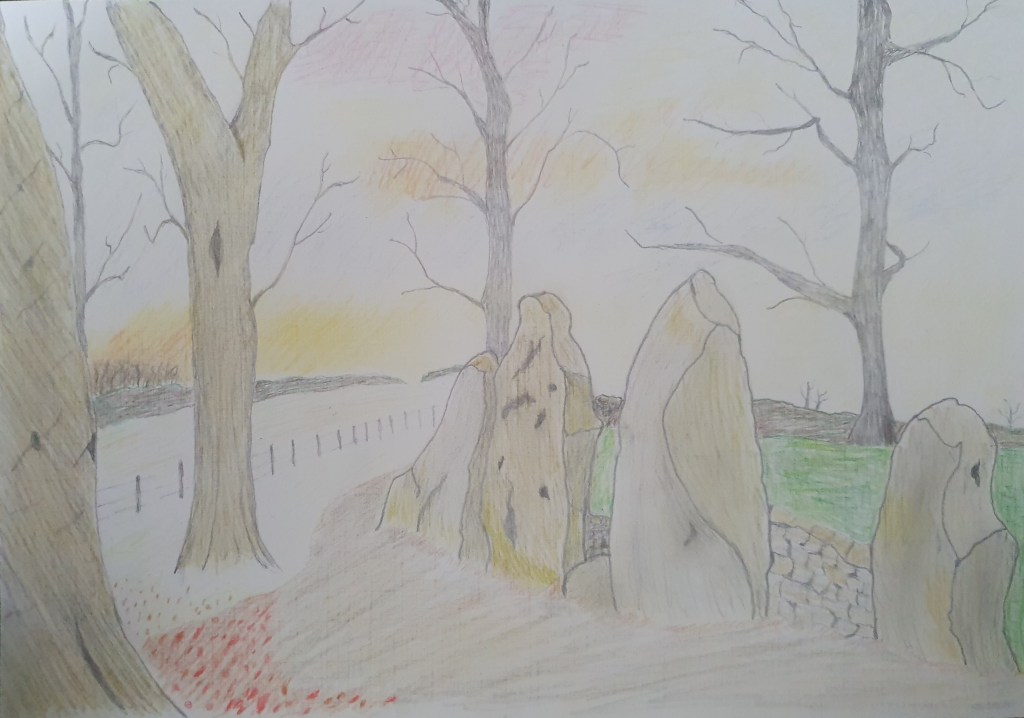
WAYLAND’S SMITHY – A CATHEDRAL OF TREES
In prehistoric times this was a coral reef and a warm shallow sea created the landscape. Billions of marine organisms left their skeletons behind to create a long ridge of white limestone that stretches from Avebury in Wiltshire 85 miles to Ivinghoe Beacon in Buckinghamshire. Over millennia the sea dried and eventually humans arrived This long hill became a trading route known as The Ridgeway. Down there on the old ocean floor was deciduous forest intersected with scrub and swamps and all kinds of creatures. Wolves and bears called this place home and they were formidable hunters. Their quarry fed humans too: deer and an enormous ox type creature called an auroch. These fierce animals could disembowel a man with a lunge of their huge horns and then stamp the corpse into the forest floor like an insignificant insect. Unfortunately for them; they tasted good, too good!
Up here on the chalk downland humans could see for miles, this was a safe place. Hunters could find flints to make tools and start their fires. Clay from the valley was used to make pots. They hunted in the forest and traded their prized dogs for spices and shells from traders who had travelled across the ocean and used this ancient path as their route to distant markets. Life here was pretty good. The people who lived here almost certainly attended the festivals and feasting at Stonehenge. They were the ones who built the White Horse that stands watch over Uffington and the vale. At this time the entire population of the United Kingdom was estimated to be just 25,000 people, please let that sink in for a moment, I’ve been to rock concerts with larger audiences!
This particular piece of hillside was home to a small group of individuals and family members. They knew where the springs bubbled up out of the ground, where the fish swam and the birds nested. They knew the plants for their medicines and the sacred places for carrying out their rituals. Everything they needed was right here. But then someone died. We don’t know who, we never will. But the love they showed for that one individual or individuals is astonishing. They couldn’t bear to let this life pass in the usual way. It was necessary to mark this person as being unique, they wanted to keep them close and remember and honour the soul they had lost. So, it was decided that a monument would be built on the hill. It had to be somewhere fitting, so a spinney of beach trees (Wayland’s Smithy) was chosen. The air in amongst these trees was, and still is, significantly different to what is outside. There is magic here for sure. It’s what I call the Cathedral of Trees (a term first used by Ralph Waldo Emerson – I realise that I stand in the shadow of his achievements). The branches overhead form the roof and the view between the trunks is like the most exquisite stained glass you will ever see. The rolling hillside, the valley below and the wonderful sky are magnificent and ever changing.
The first burial chamber was built of wood and stones and dated at about 3590 BC, but later a second larger structure was created (3460 BC) using Sarsen stones and this is what we see today. These huge stones were quarried with simple hand tools from a location near Marlborough in Wiltshire. Then these massive pieces of rock were dragged to their current resting place. We have no idea how many people it took to complete this structure or how long it took. But once on site, there was no random placing of the tomb; Its entrance is aligned so that the dead will receive daylight on the shortest day of the year. It faces the precise point of the winter solstice, a significant event in these peoples’ calendar.
Every time that I’ve entered these trees, I felt the hairs on my arms stand up. It’s a spiritual place and a link to the past. It has stood for so long and will remain long after we are gone. I’ve been to Stone Henge, back when you were allowed to touch the stones. I’ve also been to White Horse Hill (when you could stand in the horse’s eye and make a wish) and I’ve run wildly around Avebury Stone Circles with a heard of school friends; but none of them resonate with me like Wayland’s Smithy. If I’m ever tasked with finding a portal to another dimension then this place would be the first place I’d look.
Forgive my childlike artwork